










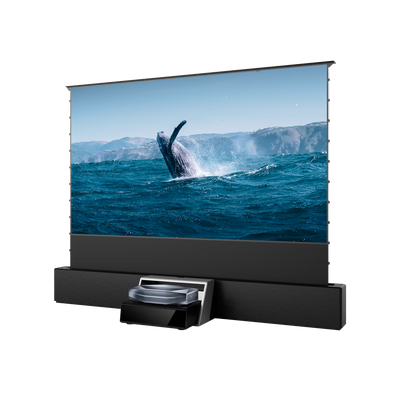
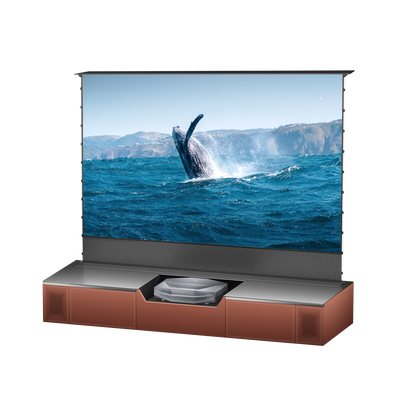
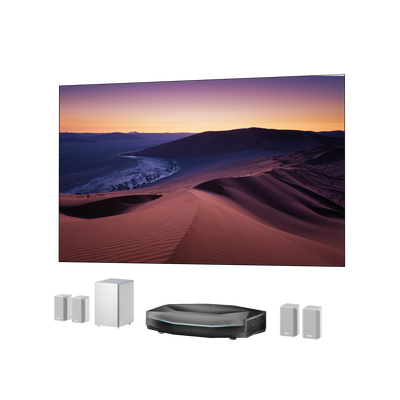


Projector Screen Material: Everything You Should Know
The same projector can look dramatically different on two different screens. One image may appear brighter, sharper, and more balanced, while the other looks flat or washed out. The difference often comes down to projector screen material. In this guide, we will explain what projector screen material is, why it matters, and how the main types differ.
Why Projector Screen Material Matters
A projector sends light to the screen, but the screen decides how that light is returned to the audience. That means screen material can visibly change the image even when the projector stays exactly the same.
Its impact is easiest to see in four areas:
-
Brightness: some materials reflect light more efficiently, while others control light more selectively.
-
Contrast and black depth: darker or light-rejecting surfaces can help the image keep better depth, especially when ambient light is present.
-
Color and detail: a smoother, more neutral surface usually produces a cleaner and more natural-looking picture.
-
Viewing consistency: some materials remain stable across a wide seating area, while others are more directional.
In simple terms, if the projector is the light source, the screen is the surface that determines how much of that performance is actually visible.
Main Types of Projector Screen Material
Projector screen materials are not all designed to do the same job. Some are made for neutral image reproduction, some for stronger contrast in ambient light, and some for the steep projection angle of UST projectors. The easiest way to understand them is to look at each material on its own.
|
Material type |
Pros |
Cons |
Best for |
|
Matte white |
Natural image, wide viewing angle, strong uniformity |
Weak against ambient light |
Dark rooms and dedicated home theaters |
|
Gray |
Better perceived black level and stronger contrast |
Lower brightness |
Mixed-light rooms with a bright projector |
|
ALR |
Handles room light better and improves daytime visibility |
More directional and usually more expensive |
Living rooms and daytime viewing |
|
CLR |
Reduces the effect of ceiling light on the image |
Mainly useful for UST-specific setups |
UST projectors in rooms with overhead light |
|
Lenticular |
Directs UST light forward effectively and helps preserve contrast |
Can be more directional off-axis |
Everyday UST viewing in living spaces |
|
Fresnel |
Strong brightness and contrast control for UST |
Placement and seating can matter more |
Bright rooms where UST performance is the priority |
|
PVC/vinyl-based |
Smooth, durable, and stable base material |
Does not describe optical performance by itself |
General-purpose screens depending on surface coating |
|
Acoustic transparent |
Allows speaker-behind-screen layouts for a cleaner setup |
Usually lower light efficiency |
Dedicated theater rooms with hidden speakers |
Matte White
Matte white is the most traditional projector screen material. It reflects light evenly, produces a natural-looking image, and usually offers a wide viewing angle. That makes it a strong option for dark rooms where image uniformity and color balance matter more than ambient light control.
Because it is a neutral surface, matte white is often the easiest material to pair with different kinds of projectors. It is especially suitable when the room is light-controlled and viewers are seated across a wider area. Its main limitation is that it does very little to reject room light, so contrast can fall quickly in brighter environments.
Gray
Gray screen material uses a darker base to improve perceived black level and contrast. It can make dark scenes look deeper than they do on a standard white surface, especially when paired with a bright projector. The trade-off is lower overall brightness, so it works best in partially controlled lighting.
Gray material is often a middle-ground choice for viewers who want more depth without moving all the way to a specialized ALR screen. It can be useful in media rooms where some ambient light is present but not overwhelming. With a lower-brightness projector, however, the image may start to look too dim.
Ambient Light Rejecting (ALR)
ALR, or ambient light rejecting material, is designed for rooms where outside light or indoor lighting cannot be fully controlled. Instead of treating all light equally, it favors the projector’s light and reduces the effect of stray light in the room. That usually helps the image look punchier during daytime or living-room use.
ALR materials are often chosen for shared family spaces rather than dedicated dark theaters. They can significantly improve perceived contrast, but they also tend to be more directional and more expensive than standard matte surfaces. In other words, they improve light control, but not without trade-offs.

CLR
CLR stands for ceiling light rejecting. It is mainly used with UST projectors, where overhead light can quickly flatten the picture. A CLR surface is designed to reduce the effect of light coming from above while still directing the projected image toward the viewer, which helps preserve contrast in brighter rooms.
Compared with general ALR materials(See ALR VS CLR Screen), CLR is more specifically tied to the viewing conditions of UST projection. It is particularly useful in rooms with ceiling lighting or reflected overhead brightness. On the other hand, it is far less relevant for standard long-throw projector setups.
Lenticular
Lenticular material uses fine optical ridges to direct a UST projector’s light forward while reducing interference from overhead ambient light. It is one of the most common UST screen structures because it balances contrast improvement with everyday usability. In return, it can be more directional than a standard matte surface.
Lenticular screens are often chosen for living-room UST systems because they offer a practical balance of contrast, image stability, and usability. They generally perform best when paired with the correct projector placement and seating position. If viewers sit too far off-axis, the image can look less consistent than it would on a more diffusive surface.
Fresnel
Fresnel material is another optical screen structure used for UST projection. It redirects light very precisely, which can create a bright and high-contrast image even in rooms with more ambient light. Because it is more focused in how it handles light, placement and seating position often matter more than with simpler materials.
This type of material is often associated with stronger daytime performance and higher image punch. However, that more focused optical behavior means it usually demands a more exact setup. It is often best suited to users who prioritize bright-room performance and are willing to be more careful with placement.

PVC
PVC or vinyl is common in projector screens because it can be made smooth, durable, and stable. In many cases, this refers more to the screen’s construction base than to its optical behavior. A PVC surface may still be matte white, gray, or another optical type depending on how it is coated and treated.
Acoustically Transparent
Acoustically transparent material is designed for setups where speakers sit behind the screen. Its woven or perforated surface lets sound pass through while keeping the image visible from the front. It is useful in dedicated theater layouts, although some versions reflect less light than a solid screen.
DIY Screen Material vs. Purpose-Built Screen Material
DIY projection surfaces can work for casual viewing, temporary setups, or entry-level use. A smooth wall, painted board, or fabric panel may be enough if the goal is simply to create a large image.
However, DIY surfaces usually lack the controlled texture, flatness, and optical consistency of a purpose-built screen. That means brightness may look uneven, colors may feel less accurate, and fine detail may not appear as clean. These differences become easier to see with larger images, higher-resolution content, and ultra short throw projectors. So while DIY has its place, dedicated screen material is usually the better choice when image quality matters.
UST Projectors Are More Sensitive to Screen Material
UST projectors are more demanding than standard projectors because they project upward from a very short distance and at a steep angle. That geometry makes surface imperfections easier to see. Small waves, ripples, or uneven texture that might go unnoticed with a standard projector can become obvious with UST.
That is also why general-purpose diffusive surfaces often fall short in UST setups. UST projectors usually benefit from specialized optical materials, including UST-focused ALR surfaces such as CLR, lenticular, and Fresnel structures, because these materials are designed to manage the light path more precisely.

Common Mistakes When Choosing Projector Screen Material
Assuming higher gain is always better
Higher gain can make the center image look brighter, but it can also narrow the viewing angle and create hot spotting. Brighter is not always better if the image becomes less consistent across the screen.
Ignoring viewing angle
Some screen materials are more directional than others. A screen that looks excellent from the center seat may appear dimmer or less balanced from the side. This matters in family rooms and wider seating layouts.
Treating all projector types the same
Standard long-throw and ultra short throw projectors do not interact with the screen in the same way. A surface that works well for one setup may not perform nearly as well for the other.
Underestimating surface flatness
Even the right optical material can underperform if the surface is not smooth and stable. Flatness matters because the cleaner the screen surface is, the cleaner the projected image tends to look.
Conclusion
Projector screen material shapes the image more than many people expect. From matte white to PVC surfaces, each material is designed to solve a different problem. The best screen material is not simply the most advanced one, but the one that matches how and where the projector will actually be used. Understanding those differences makes it much easier to choose a screen surface that fits the way a system will actually be used.
FAQ
What is projector screen material?
Projector screen material is the surface and construction used to reflect projected light. It affects brightness, contrast, color accuracy, sharpness, and how well the image performs in different lighting conditions.
Is PVC good for projector screens?
PVC can be very good when it is part of a purpose-built screen. The key is not the word “PVC” alone, but how the surface is coated, tensioned, and finished for image quality.
Does a UST projector need special screen material?
Usually yes. UST projectors throw light from below at a steep angle, so specialized materials such as CLR, lenticular, or Fresnel structures are often better suited to that projection path.
What screen material works best for 4K projection?
For 4K projection, smoother and finer screen surfaces are generally better because coarse texture can affect visible detail. A flatter, cleaner surface usually preserves sharpness more effectively.
Be the First to Know
Subscribe for special deals, news, and important product information, and get your exclusive $100 discount.
Related Articles
Upgrade Your UST Setup: Is AWOL LuxVision Right for Your Room?
Black Projector Screen: Is It Right for Your Room?
WiFi Projector Buying Guide: Features That Actually Matter
How to Create a Modern Living Room with an Ultra Short Throw Projector Cabinet?
Rear Projection Screen Guide: Best Materials Options