












Rec2020 Explained: Color Gamut, HDR and Picture Quality
Rec. 2020, also known as BT.2020, defines a much wider color gamut than Rec. 709 and DCI-P3, allowing video to represent a broader range of saturated colors. For home theater viewing, this expanded range can make a visible difference in HDR movies and other wide-gamut content.
However, support for Rec. 2020 does not guarantee that its full color range will appear on screen. Many HDR movies are mastered within the smaller P3-D65 gamut, and displays vary in how much of Rec. 2020 they can reproduce.
So what does Rec. 2020 actually mean for picture quality? The answer depends on the colors in the source, the display's native gamut, and how accurately it reproduces them.
What Is Rec. 2020 (BT.2020)?
Rec. 2020 is an International Telecommunication Union Radiocommunication Sector (ITU-R) recommendation defining image parameters for ultra-high-definition television (UHDTV). It specifies 4K and 8K resolutions, frame rates, color primaries, and digital signal representation. Its wide color gamut is particularly relevant to modern displays and HDR video.
How Does Rec. 2020 Define a Color Gamut?
A color gamut describes the range of colors a color system can represent. On the CIE 1931 chromaticity diagram, the red, green, and blue primaries define three points. Connecting them forms a triangle that outlines the system's color gamut.
Rec. 2020 specifies these primary coordinates:
|
Primary Color |
CIE x |
CIE y |
|
Red |
0.708 |
0.292 |
|
Green |
0.170 |
0.797 |
|
Blue |
0.131 |
0.046 |
The three primaries lie very close to the spectral locus, the boundary of the CIE 1931 diagram representing monochromatic light. Their positions give Rec2020 an exceptionally wide gamut, including saturated greens and cyans beyond the traditional HDTV color range.
These coordinates define the standard's reference color gamut, not how much of that range a particular projector can reproduce.
Rec. 2020 vs. Rec. 709 vs. DCI-P3
Rec. 709, DCI-P3, and Rec. 2020 define different color gamuts for television and cinema applications. Rec. 709 is the established HDTV reference, DCI-P3 was developed for digital cinema, and Rec. 2020 defines a wider reference gamut for UHD television.
|
Color Standard |
Approx. CIE 1931 Area |
Typical Use |
|
Rec. 709 |
35.90% |
HDTV and SDR video |
|
DCI-P3 |
53.60% |
Digital cinema projection and mastering |
|
Rec. 2020 |
75.80% |
UHD video and wide-gamut HDR distribution |
The percentages represent approximate two-dimensional gamut areas relative to the CIE 1931 chromaticity diagram. They are not measurements of a display's gamut coverage or three-dimensional color volume.
How Does Rec. 2020 Compare with Rec. 709?
Rec. 2020 extends beyond Rec. 709, particularly toward saturated greens and cyans. With suitable wide-gamut content, a display capable of reproducing these additional colors can show colors that a display limited to Rec. 709 cannot.
For conventional SDR video, however, a wider output color space doesn't reveal colors that were never present in the original recording. Proper color management should preserve the intended Rec. 709 appearance rather than making the image more saturated simply because the projector supports a larger gamut.
For more about the HDTV standard, see our guide to the Rec. 709 color gamut.
Rec. 2020 vs. DCI-P3: Which Has a Wider Color Gamut?
Rec. 2020 covers a wider color gamut than DCI-P3, extending considerably farther into highly saturated greens.
DCI-P3 was developed for digital cinema. The related P3-D65 gamut uses the same RGB primaries but a D65 white point and is common in HDR movie mastering. A film graded within P3-D65 can still be delivered using BT.2020 color encoding; that signal format does not, by itself, indicate whether the movie contains colors beyond P3.
Does a Wider Color Gamut Always Mean Better Picture Quality?
A wider color gamut allows a display to reproduce more colors, but picture quality also depends on color accuracy—how closely those colors match their intended appearance.
For example, a wide-gamut projector may display unnaturally saturated skin tones if it doesn't handle the source's color space correctly. Even with a smaller gamut, accurate color reproduction can produce a more natural-looking image. For practical guidance on adjusting hue, saturation, and other color settings, see our guide to calibrating the colors on a laser projector.
A wider gamut is most beneficial when the source contains colors beyond a smaller reference gamut and the display can reproduce those colors accurately.

Is Rec. 2020 the Same as HDR?
No. Rec. 2020 defines UHD television image parameters, including color primaries. High Dynamic Range (HDR) deals with representing a wider range of luminance. Modern video often combines the two, but a BT.2020 color signal is not necessarily HDR.
Rec. 2020 vs. Rec. 2100: What Is the Difference?
BT.2020 sets out UHD television image parameters. BT.2100 specifies HDR television image systems. Both use the same RGB color primaries, but BT.2100 defines the transfer functions needed for HDR luminance representation.
Those functions include Perceptual Quantizer (PQ), which follows an absolute luminance scale and underpins HDR10, and Hybrid Log-Gamma (HLG), which uses a relative approach suited to applications such as HDR broadcasting.
BT.2100 therefore adds HDR-specific image requirements without expanding the Rec2020 reference color gamut.
Do Movies Actually Use the Full Rec. 2020 Color Gamut?
Many HDR movies are mastered within a P3-sized gamut, even though their home-release signals use BT.2020 encoding.
Consider an Ultra HD Blu-ray movie graded within P3-D65. Its colors can be represented in a BT.2020 signal without extending to the full boundaries of Rec2020.
However, not every HDR production is confined to P3. The colors available in a production depend on the capture equipment, reference displays, grading workflow, and creative decisions. Some content may contain colors beyond P3.
If a movie's intended colors remain within P3-D65, additional gamut beyond that range offers little direct benefit for reproducing those colors.
Why Is Full Rec. 2020 Coverage So Difficult to Achieve?
The challenge starts with the reference primaries. Rec. 2020 places them very close to the spectral locus of the CIE 1931 chromaticity diagram, calling for extremely saturated red, green, and blue. Conventional broad-spectrum light sources generally produce less saturated primaries, making those boundaries difficult to reach.
A projector also has to balance its light source with optical efficiency, usable brightness, and color accuracy. Extending the native gamut is only one part of reproducing a high-quality image.
How RGB Triple-Laser Technology Approaches Rec. 2020 Primaries
RGB triple-laser projectors use separate red, green, and blue laser sources with relatively narrow emission spectra. By selecting suitable wavelengths, manufacturers can produce highly saturated primary colors that approach the Rec. 2020 reference coordinates, expanding the range of reproducible colors.
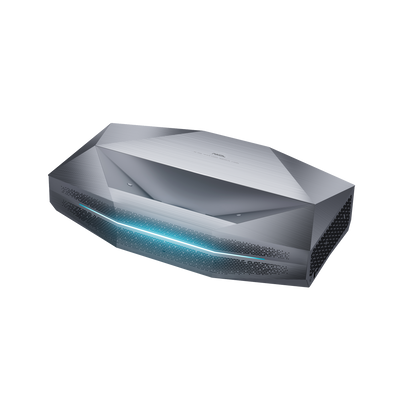
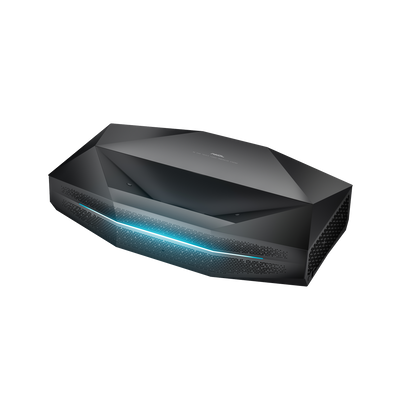
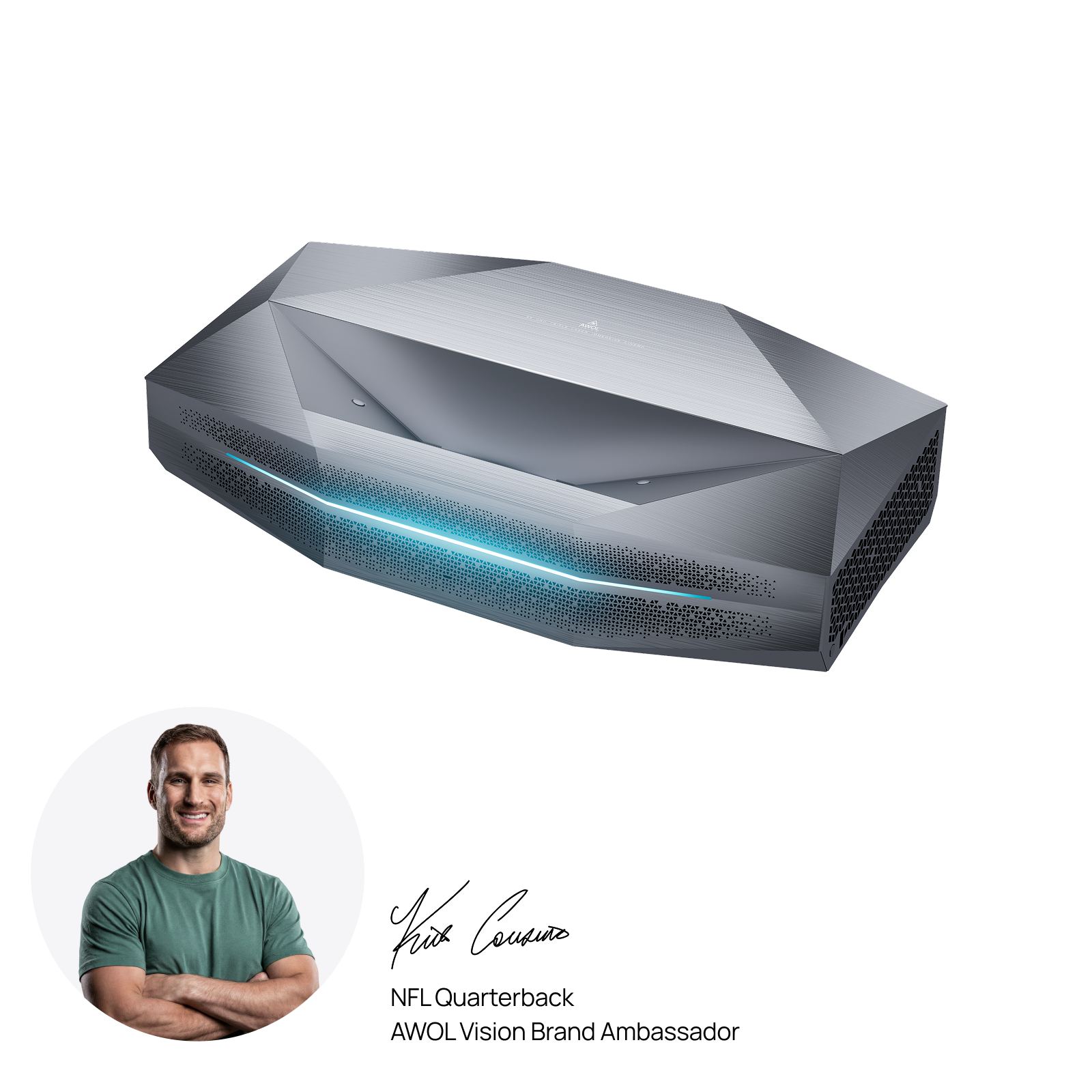
For example, the AWOL Vision Aetherion Max uses RGB triple-laser technology to deliver a wide color gamut for home theater viewing.
Beyond the laser wavelengths, optical design and color management also influence the projector's overall color performance. Our guide to understanding color space explains these factors in more detail.
Can Projectors Display the Full Rec. 2020 Color Gamut?
RGB triple-laser projection can achieve exceptionally wide color gamuts, but full coverage of the Rec. 2020 reference gamut depends on the projector's native color capabilities.
To evaluate a projector's actual color capabilities, distinguish three things: signal compatibility, gamut area, and actual coverage.
What Does "Rec. 2020 Compatible" Actually Mean?
A projector described as Rec. 2020 compatible can accept and process video signals carrying BT.2020 color information. Its native color gamut determines which colors it can physically reproduce.
For example, a projector with a P3-sized native gamut can still play HDR content encoded in BT.2020, provided it supports the relevant signal format. Colors within its reproducible gamut can be displayed, while colors outside that range must be mapped or otherwise adapted to the projector's capabilities.
Signal compatibility is therefore important for playing the intended content, but it does not establish how much of the source's color range the projector can reproduce.
Color Gamut Area vs. Actual Coverage
Gamut area and gamut coverage measure different aspects of a display's color capabilities.
- Gamut area: The size of a display's color gamut relative to a reference gamut, based on a specified measurement method.
- Gamut coverage: The proportion of the reference gamut that falls within the display's reproducible gamut.
A projector can have a gamut area exceeding 100% of the reference gamut while covering less than 100% of it. Its color triangle may extend beyond some reference boundaries while failing to reach others.
These two-dimensional measurements also do not describe the full range of colors a display can reproduce at different brightness levels. That broader capability is described by color volume.
How to Interpret Projector Color Gamut Specifications
When reviewing a projector's color gamut specifications, focus on three points:
- Identify the measurement. Check whether the percentage refers to gamut area or coverage rather than comparing the numbers alone.
- Check the measurement method. Look at the reference color space, chromaticity diagram, and testing procedure, as results obtained using different methods may not be directly comparable.
- Consider color accuracy. A wider gamut expands the range of available colors, while color accuracy indicates how faithfully the display reproduces the intended colors.
How to Choose a Projector for Wide-Color-Gamut Content
A projector's Rec. 2020 specification is an important consideration, but it doesn't tell the whole story. Color gamut coverage, HDR performance, and viewing conditions all influence how accurately and vividly content appears on screen.
Check Color Gamut Coverage and Accuracy
For HDR movies, strong P3-D65 coverage is a useful starting point, as many films are mastered within this color gamut. Accurate color reproduction helps preserve the intended appearance, while wider Rec. 2020 capability provides additional range for content containing colors beyond P3-D65.
A two-dimensional CIE gamut chart shows which chromaticities a display can reproduce, but not how its color capabilities change with brightness. A projector may reproduce a highly saturated color at moderate brightness yet have a more limited range of saturated colors at higher brightness levels. Color volume helps explain these differences in HDR performance, even between displays with similar gamut coverage.
Consider Brightness, Contrast, and HDR Tone Mapping
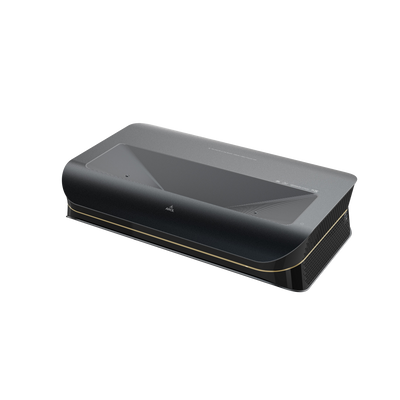
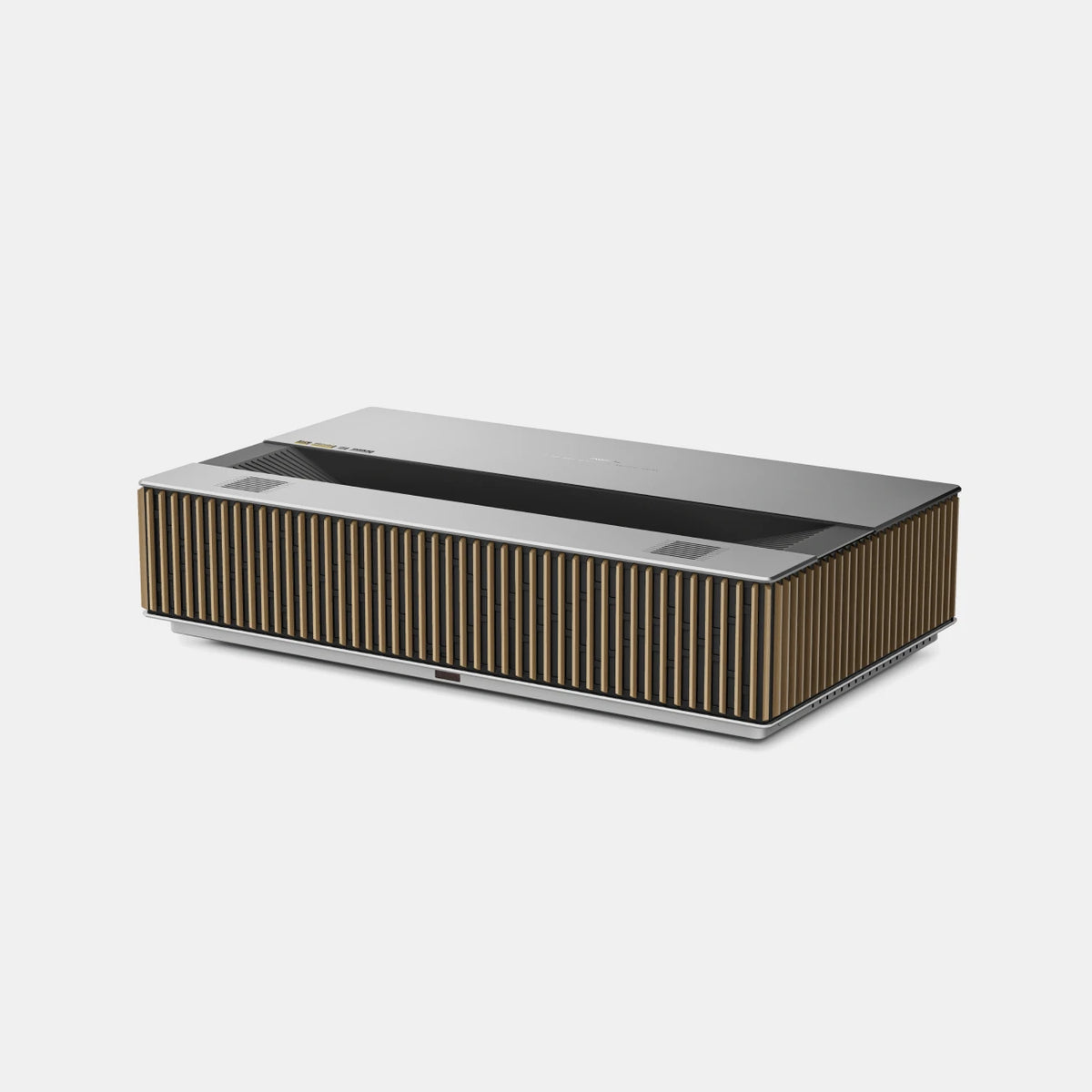
Brightness becomes particularly important on larger screens or in rooms with ambient light, while contrast affects the separation between bright and dark areas. HDR tone mapping adapts the source's luminance range to the projector's capabilities, helping preserve highlight and shadow detail within its available brightness range. The AWOL Vision LuxVision combines RGB triple-laser technology, 6,000 ISO lumens, and Dynamic Tone Mapping, bringing together wide-gamut color, high light output, and HDR processing in one projector. For a closer look at this technology, read our article on dynamic tone mapping.
Match the Projector to Your Content and Viewing Environment
For SDR television, prioritize accurate Rec. 709 reproduction rather than maximum gamut size. For UHD Blu-ray and HDR streaming, look for strong P3-D65 coverage, reliable HDR processing, and appropriate format compatibility. Wider Rec. 2020 capability offers additional color range when the content contains colors beyond P3-D65.
Viewing conditions also influence your choice. Larger screens require more light output to maintain similar brightness, while rooms with ambient light benefit from suitable brightness and light control.
FAQs
Should I Set My Projector to Rec. 2020 for Every Movie?
No. Match the color mode to the source rather than forcing the widest available gamut. SDR movies mastered in Rec. 709 should normally be displayed in that color space.
For HDR content delivered with BT.2020 color information, use a compatible picture mode or automatic color management if the projector supports it. The aim is accurate reproduction, not making every movie more saturated.
Does Dolby Vision Use the Full Rec. 2020 Color Gamut?
Not necessarily. Dolby Vision supports wide-gamut HDR, but the format doesn't mean a movie uses every color within Rec. 2020. Its actual color range depends on the master.
Dolby Vision's dynamic metadata helps compatible displays adapt HDR content to their brightness capabilities, even when the movie's colors remain within a P3-sized gamut.
Is Rec. 2020 Better for Gaming?
Rec. 2020 support can benefit HDR games that contain wide-gamut colors, provided the display reproduces them accurately. This can enhance the appearance of certain environments and visual effects, but it does not directly improve refresh rate or reduce input lag.
For gaming, HDR tone mapping, input latency, refresh rate, and compatibility with your console or PC are also important considerations.
Be the First to Know
Subscribe for special deals, news, and important product information, and get your exclusive $100 discount.
Related Articles
Projector Says No Signal? How to Find and Fix the Problem
Why Is My Projector Blurry? 8 Causes and the Fixes That Work

Projector Lens Shift Explained: How Much Placement Freedom You Actually Get
Projector Lens Replacement: Can You Replace or Repair the Lens?
What Does a 4K 120Hz Projector Mean and Why Does It Matter?