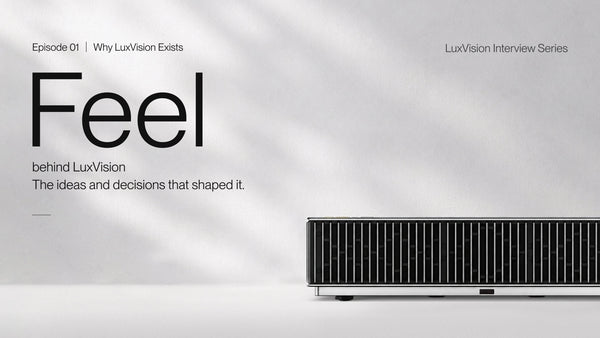

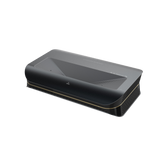











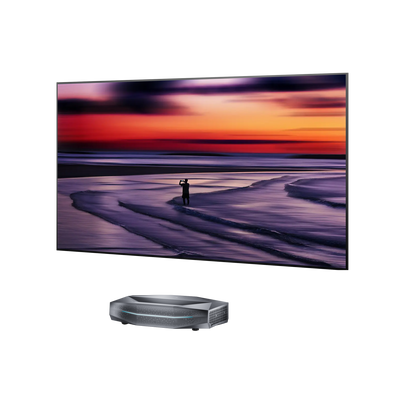
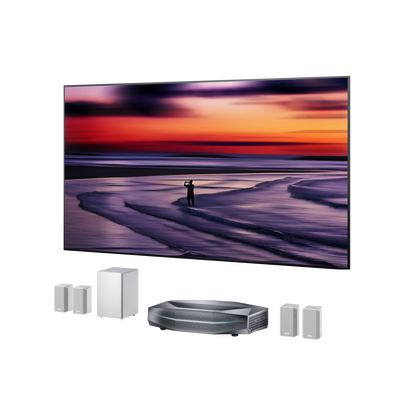


Feel · Behind LuxVision | The Vision Behind AWOL LuxVision
Meet Eason
Eason
CTO · LuxVision Project Lead
6 Years in Projection & Home Entertainment · At AWOL Since 2020

“There Will Be Miracles When You Believe.”
For Eason, LuxVision did not begin with a single specification.
It began with a question that AWOL had been asking for years: What would it take for ultra-short-throw projection to truly belong in the everyday living room?
Ultra-short-throw projectors have existed for more than a decade, yet they have remained far from mainstream consumer products. The technology has continued to evolve, but many users still associate projection with dark rooms, complicated installation, and products that require them to adapt their homes around the device.
AWOL had already been working on this problem through its earlier UST products. Those experiences made one thing increasingly clear to Eason and the engineering team: making a projector more powerful was only part of the answer.
A next-generation UST would need to be brighter, easier to install, more adaptable to real living spaces, and more natural to use every day.
That became the starting point for LuxVision. Not simply a higher-performance UST, but a UST designed around the room it lives in.
What Is Still Missing From UST?
From Eason's perspective, the next generation of UST has to move beyond the traditional competition around specifications.
Brightness still matters, because a projector cannot become a truly everyday living-room display if users constantly have to think about whether the lights are on or the curtains are open. But brightness itself is difficult to achieve in an ultra-short-throw optical system. Unlike conventional long-throw projection, UST relies on a highly complex optical path that includes a reflective surface, making light efficiency and thermal management particularly demanding.
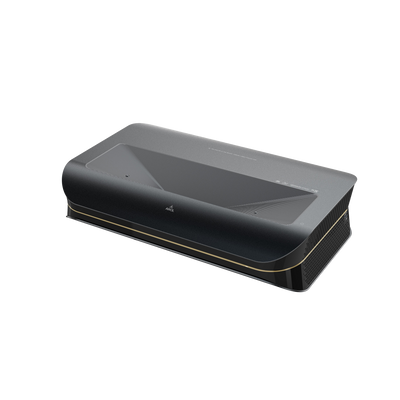
LuxVision was developed with this challenge in mind. Through work on the optical structure, reflective-surface coatings, and thermal management, the team pushed the system to 6,000 ISO Lumens.
For Eason, the significance of that number is not simply that it is higher than before. It represents a step toward making projection more practical in the environments where people actually live.
But brightness is only one part of the problem.
The second is installation.
Most living rooms are not designed around a projector. A family may already have a TV cabinet, a fixed screen, existing furniture, or a carefully finished wall. Replacing an existing UST should not mean moving the cabinet, recalculating screen height, adding spacers, drilling new holes, and spending an afternoon trying to align the image.
That is why LuxVision approaches installation differently.
Optical Shift, together with automatic screen fit, automatic keystone correction, and obstacle avoidance, is intended to make setup more forgiving. Instead of forcing the room to accommodate the projector, the projector gains more ability to adapt to the room.
This becomes especially important when upgrading an existing system. The value of Optical Shift is not simply that the image can move. It is that a change of projector does not necessarily have to become a renovation project.
The third challenge is everyday use.
A living room is not a dedicated home theater. People may watch a movie one evening, a sports game the next, play games with friends, stream a series, or cast something directly from a phone. The equipment around the screen also tends to be much simpler than a dedicated cinema room.
That is why Eason sees LuxVision not simply as a projector, but as a smart device designed around everyday entertainment — one that should make streaming, casting, voice control, gaming, sports, and other forms of content feel natural within the same space.
And then there is the room itself.
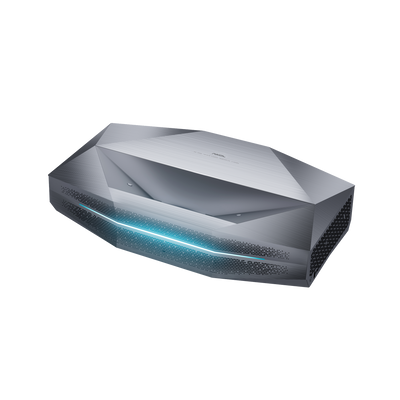
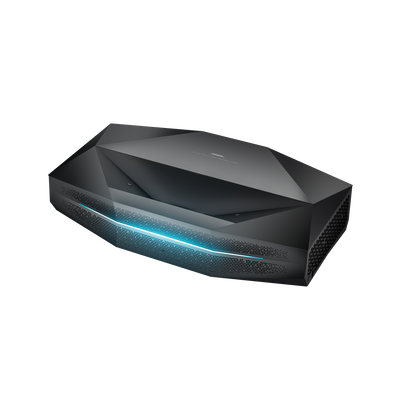
A projector may have exceptional image quality, but if it feels disconnected from the furniture and interior around it, the experience is incomplete. This is why LuxVision's different CMF options are not simply additional colors. They are part of a broader attempt to make the projector belong to different types of homes.
For Eason, these four challenges define what the next generation of UST should be:
Brighter performance, easier setup, more natural everyday use, and a stronger relationship with the home.

Why Optical Shift Matters More Than Another Number
LuxVision includes several specifications that define its flagship-level performance, including 4K 120Hz and 6,000 ISO Lumens.
But if Eason had to choose the capability that most clearly represents what makes LuxVision different, his answer would be Optical Shift.
The reason is that brightness and refresh rate primarily improve what happens on the screen. Optical Shift changes the relationship between the projector and the physical space around it.
UST projection is particularly sensitive to position because the image is created from a very short distance. A small change in the optical system can have a much larger effect across the projected image than it would on a conventional long-throw projector.
That makes optical lens movement far more complicated than simply shifting a digital image.
LuxVision's approach moves the optical lens assembly itself, allowing the projected image to be repositioned without relying on digital image correction as the primary solution.
For the user, however, the technical distinction only matters if it makes life easier.
A first-time UST owner can gain more flexibility when aligning the projector with the screen. An existing UST owner can upgrade without automatically having to redesign the relationship between the projector, cabinet, and screen.
This is why Eason sees Optical Shift as more than a feature. It changes where the projector can live and how easily it can adapt to the space around it. And that, ultimately, is much closer to the problem LuxVision was created to solve.
When a Difficult Technology Solves a Simple Problem
The idea behind Optical Shift had been present in AWOL's product development experience for years.
The team had repeatedly heard the same type of feedback from UST users: installation was manageable once the system was in place, but changing the system later could be surprisingly difficult. Existing furniture and screens created constraints, while even small differences in projector geometry could force users to adjust their setup.
The question became straightforward: Could the projector adapt to the room instead of asking the room to adapt to the projector?
The answer was technically much less straightforward.
The UST optical path is highly sensitive, and moving the entire lens assembly introduces demanding mechanical requirements. Verticality, flatness, friction, structural precision, and motor control all have to work together. If the mechanism is too tight, the motor cannot move it reliably. If it is too loose, the lens can tilt during movement. Even a small mechanical deviation can become visible across a large projected image.
The team considered different approaches before settling on an optical path that built on AWOL's existing experience with lens mechanisms.
The development process ultimately took roughly a year to a year and a half of engineering work, including collaboration with the lens supply chain and repeated verification.
The reason the team kept going was not because the technology looked impressive on a specification sheet.
It was because the problem was real.
For Eason, that is an important distinction in product development. A technically difficult feature is only worth pursuing when it makes a meaningful difference to the way people use the product.
Optical Shift happened to be both.
Beyond the Projector: Building a Cinema System
There is another lesson that came from working on LuxVision: a projector's performance cannot be separated completely from the environment in which it is used.
Even at 6,000 ISO Lumens, the final image depends on the room. Windows, lighting, walls, furniture, and reflected ambient light can all influence perceived contrast, black levels, and overall image quality.
That is why AWOL does not view the screen as simply an accessory to LuxVision.
The projector generates the image, but the screen determines how much of that image can be preserved and perceived in the real environment.
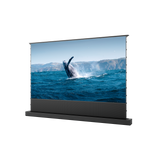
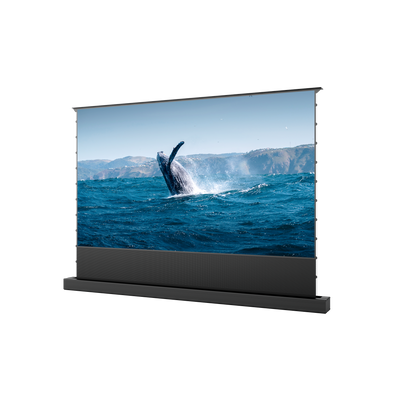
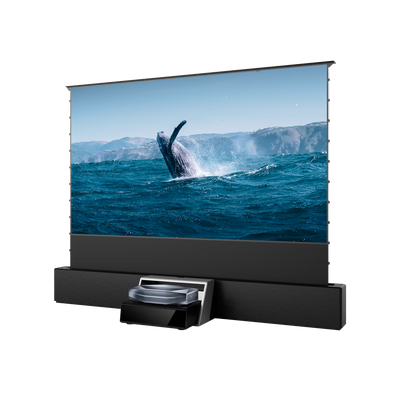
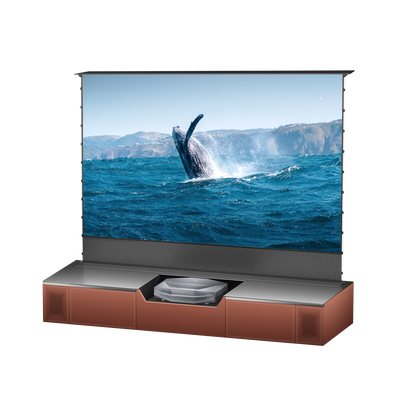
For living-room projection in particular, an appropriate ALR Screen can help reject part of the ambient light and improve the overall viewing experience. The goal is not to make the projector specification look better on paper, but to make the complete system perform better in the room where the user will actually watch it.

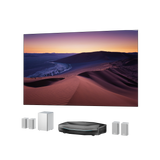
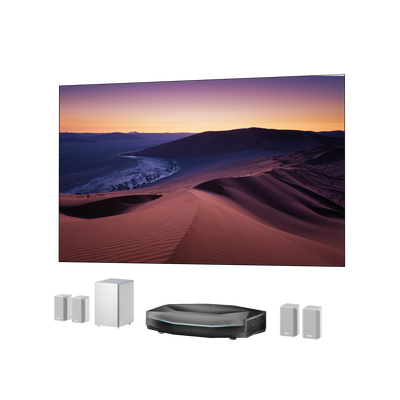
This is the thinking behind positioning LuxVision + ALR Screen as a Cinema System.
The same principle extends beyond the screen. The ideal experience may involve a cabinet, audio system, cables, installation method, and other components that all need to work together.
From the user's perspective, however, these should not feel like separate technical problems. They should feel like one solution. The user should not have to become an expert in projectors, screens, cabinets, and connections simply to enjoy a large-screen experience.
That is where LuxVision's longer-term direction begins to emerge.
Designing Around the User, Not the Specification Sheet
For Eason, deciding what belongs in LuxVision is not simply a matter of following the latest technology.
The team looks at user feedback, market research, product data, sales and service information, and direct research with users. Ideas are then tested through interviews, questionnaires, and A/B testing before they become part of a larger product direction.
This approach also explains why LuxVision includes capabilities that may not be immediately obvious from its headline specifications.
One example is MultiView.

The feature required substantial development and testing, but its origins were not simply technological curiosity. The team had seen users purchasing third-party MultiView devices to combine multiple input sources, only to encounter limitations such as compatibility issues with 3D, Dolby Vision, HDR10+, and other projector capabilities.
Rather than asking users to accept those compromises, AWOL chose to develop the functionality into the product itself.
That opens up scenarios that are still relatively new in the home: watching multiple sports games at once, viewing different perspectives while gaming, or sharing several sources on one large screen.
For Eason, this is what separates a specification-driven product from a scenario-driven one.
The question is not simply “What can the technology do?” It is “What can the user do with it?” That shift in perspective is central to how AWOL approaches LuxVision.
Born for the Living Room
If there is one phrase Eason would use to describe LuxVision, it is “the king of the living room.”
The ambition behind that phrase is not to claim that a projector should dominate the room. It is to describe a product that can bring together image performance, installation flexibility, smart functionality, design, and the surrounding entertainment ecosystem in one everyday space.
A dedicated home theater will always have its own advantages. It can be designed specifically for controlled lighting, dedicated equipment, and the highest possible level of cinematic optimization.
But the living room serves a different purpose. It is where families spend time together. It is where friends watch sports, where people play games, where movies are shared, and where entertainment happens without requiring the room to be transformed first.
That is the space LuxVision was designed around.
In Eason's view, the longer-term goal is not necessarily to sell a projector as an isolated device. Ideally, the projector, screen, cabinet, audio, and installation could work together as a complete cinema solution, while still giving users the flexibility to choose the elements that fit their own homes.
The technology may begin with the projector, but the experience should extend beyond it.
What Comes Next for the Big Screen?
Eason remains optimistic about projection, but he does not believe its future depends on replacing every television.
Instead, he sees projection as one part of a broader future for large-screen entertainment.
The industry still has significant challenges. One is awareness: many consumers still associate projection with old experiences such as classrooms, conference rooms, or dark environments where image quality depended heavily on controlling the light.
Another is accessibility. As optical technology, semiconductors, and the wider supply chain mature, high-quality projection should become accessible to more people rather than remaining a niche product for a relatively small group of enthusiasts.
And the industry also needs to build long-term trust. If competition becomes focused only on specifications and price, or if specifications are presented without translating into meaningful real-world performance, users may become disappointed not only with an individual product but with the category itself.
For Eason, better products and better education need to happen together.
Projection has a fundamental advantage that gives it room to evolve: the light source, imaging system, and display surface can be separated. That creates possibilities in size, installation, and spatial design that are difficult to achieve with conventional self-emissive displays.
A large screen can become something shared rather than something designed for a single viewer.
That is why he sees the future of large-screen entertainment as complementary rather than purely competitive — with traditional TVs, personal display devices, and projection each serving different needs.
And for AWOL, the focus remains clear: large-screen entertainment built around real spaces and real users.

From a Projector to an Ecosystem
The long-term direction of AWOL extends beyond a single projector model.
Different spaces create different requirements. A living room, a dedicated cinema room, and even an outdoor space each demand a different approach to screen size, installation, audio, lighting, and interaction.
The goal is therefore to gradually connect the products and technologies around these scenarios so that users can choose an experience rather than assemble a system from scratch.
Instead of asking users to figure out which projector, which screen, which cabinet, which audio system, and which accessories they need, the ideal experience is much simpler:
Tell us what you want to experience in your space, and let the system do the rest.
That is the direction behind AWOL's broader vision of a home entertainment ecosystem.
LuxVision represents an important step in that direction because it brings together several of the problems the team has been working on for years: brightness, installation flexibility, image performance, smart functionality, design, and the relationship between the product and the room.
It is not the end of that journey.
It is a clearer expression of where the journey is going.
Why We Built LuxVision
The story of LuxVision began with a limitation.
UST had already demonstrated that a projector could create an enormous screen from an incredibly short distance, but the experience still asked users to make too many compromises — around light, installation, furniture, daily use, and the way the product fit into the home.
The four episodes of Feel · Behind LuxVision have looked at that journey from different perspectives.
Bilie showed us why LuxVision needed to exist — to make a large-screen experience more effortless and flexible.
Sunny showed us how that experience is proven — through relentless testing, tuning, and attention to what users actually see and feel.
Elon showed us how LuxVision enters the home — through architecture-inspired proportions, materials, craftsmanship, and a design philosophy built around the space.
And Eason brings the story back to the beginning: why all of these decisions had to come together in the first place.
LuxVision was not built simply to add another high-performance projector to the market.
It was built around a larger idea: A projector should adapt to the way people live.
It should be bright enough for the living room, flexible enough for real-world installation, powerful enough for demanding content, refined enough to belong in the home, and simple enough that users can focus on what they came to experience in the first place.
That is what Eason means by building the “king of the living room.” And that is also the most fitting way to close the story Feel · Behind LuxVision.
Because the ultimate goal was never just to make a better projector.
It was to make the experience of living with a projector feel better.
Be the First to Know
Subscribe for special deals, news, and important product information, and get your exclusive $100 discount.
Related Articles
Feel · Behind LuxVision | The Design Behind AWOL LuxVision
Feel · Behind LuxVision | Behind AWOL LuxVision’s Picture Quality