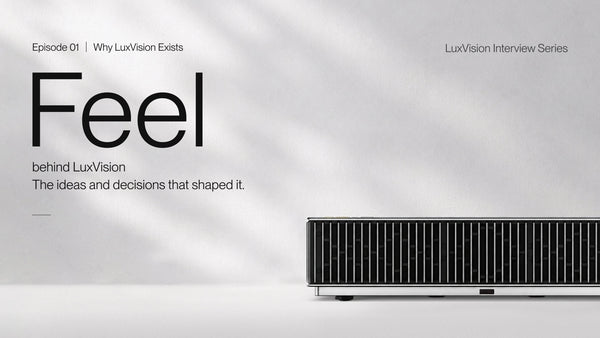

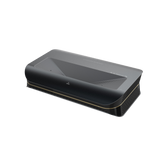


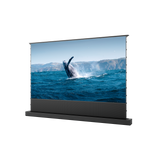







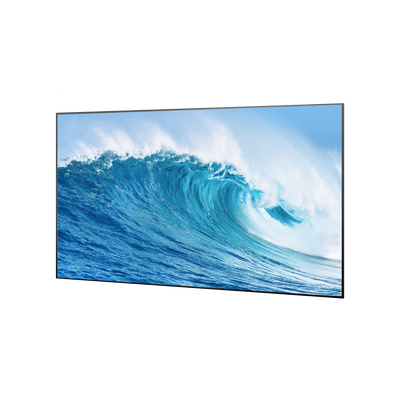




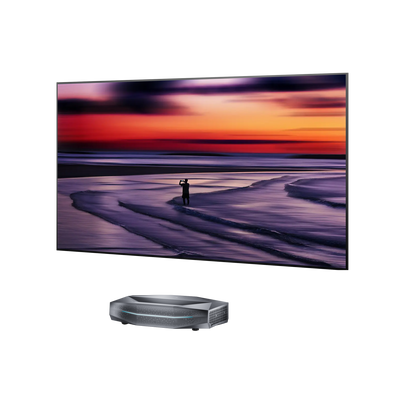


Feel · Behind LuxVision | Behind AWOL LuxVision’s Picture Quality
Meet Sunny

Sunny
Software Product Manager · LuxVision
6 Years in Display & Home Entertainment
At AWOL Vision since 2020, Sunny works across software feature planning, image quality and software quality.
But when he talks about his work, he doesn't start with specifications.
He starts with a question: What does the user actually see?
Because for Sunny, a projector can have impressive numbers on paper and still leave room for improvement.
The real test begins when you sit down and watch.
“The Lab Is Really About Finding Faults.”
AWOL has its own laboratory, but Sunny's description of what happens there is surprisingly simple.
“The work in the lab isn't always as glamorous as people imagine.”
A machine turns on.
They play a movie.
They watch.
Something doesn't look quite right.
Pause.
Adjust a few parameters.
Play it again.
Sometimes, the team can spend an entire afternoon working on a small detail in a dark scene.
Maybe the final adjustment changes only a small part of the brightness range—something most users may never consciously notice.
But the team knows when it feels right.
Sunny calls the process “picking faults.”
Not because something is necessarily wrong, but because the team keeps asking whether it can be better.
And that means watching the same scene again and again.
Testing the Way People Actually Watch
A projector rarely lives in a perfectly controlled room.
So neither can the testing.
The team compares images under different conditions:
Different screens.
Different levels of ambient light.
Lights on and off.
Curtains fully open.
Curtains half closed.
Different viewing environments.
The goal isn't simply to find the perfect result under laboratory conditions.
It is to understand what happens when the projector enters a real home.
Because the same image can feel very different depending on the environment around it.
For Sunny, this is where testing becomes more than measurement.
It becomes experience.
“Real users will encounter all kinds of situations at home. We try to recreate those situations in the lab first.”

Parameters Are the Starting Point. Experience Is the Goal.
So which matters more—parameters or experience?
Sunny's answer is straightforward:
“Parameters are the foundation. Experience is the goal.”
Numbers are important.
They provide a common language for measuring performance and setting a technical baseline.
But numbers alone don't tell the whole story.
A user may know that a projector has a certain brightness rating, but that number doesn't tell them how the picture will actually look when sunlight enters the room.
The same is true for contrast.
A specification can tell you a number.
It doesn't necessarily tell you how much detail you will actually see in a dark scene.
That's why Sunny and the team don't simply adjust the projector by looking at instruments.
They watch real content.
HDR movies.
Bright scenes.
Dark scenes.
Fast-moving sequences.
Different screens.
Different lighting conditions.
They watch the same content in different environments and keep refining the image until the experience feels right.
“Users may not be able to explain exactly what is better. But they can feel when an image is comfortable to watch.”
For Sunny, that's the point of calibration.

When 4K 120Hz Becomes Something You Can Feel
LuxVision's 4K 120Hz capability is another example of the difference between a specification and an experience.
120Hz isn't simply a bigger number than 60Hz.
It changes how the system handles motion—and what the viewer sees when images move quickly.
For movies and video, a higher refresh rate gives the system more room to process motion. For gaming, it can support smoother motion and more responsive visual feedback.
For sports, it can help preserve detail in fast-moving scenes.
But Sunny doesn't believe in explaining technology simply for the sake of explaining technology.
The more important question is:
Can the viewer actually see the difference?
That's why the team uses real content to validate the system.
Fast action scenes.
Sports.
Games.
Different types of motion.
Different display conditions.
The team looks beyond whether the projector can simply recognize and output a 4K@120Hz signal.
They ask whether the improvement survives all the way to the viewing experience.
Because the goal isn't: “It supports 120Hz.”
The goal is: “It looks better when things move.”

Making Ultra-Short Throw More Forgiving
The same philosophy applies to LuxVision's Optical Shift.
Ultra-short-throw projection gives users the advantage of a large image from a very short distance, but installation can also leave little room for error.
The position of the projector and screen matters.
Even small adjustments can affect alignment.
Optical Shift gives users more flexibility by physically repositioning the projected image without relying on digital image correction.
For Sunny, the value isn't the mechanism itself.
It's what happens afterward.
Less time moving the projector.
Less need to adjust the screen.
Less frustration during installation.
More freedom to make the projector work with the room.
Again, the technology disappears into the experience.
The Hardest Test May Be the Longest One
For Sunny, image quality isn't something that should only look good for a few minutes.
It needs to remain consistent.
That is why thermal performance became another important part of LuxVision's development.
In an ultra-short-throw projector, heat management is particularly challenging because of the optical architecture and the concentration of heat around the light path.
If thermal conditions aren't properly controlled, they can affect brightness, fan noise and image consistency over time.
The team therefore approached cooling as a system-level problem—not simply a matter of adding a larger fan.
Airflow.
Thermal materials.
Heat management.
System behavior.
All of these had to work together.
The result is something users may never consciously notice.
And that's exactly the point.
“Users won't say, ‘The thermal system works well.’ They'll say, ‘I've been watching for three hours, and the picture is still clear and the projector isn't distracting me.’”
For Sunny, that is what successful engineering looks like.
Beyond the Numbers
The team also spent time refining LuxVision's second-generation Anti-RBE system.
Rather than relying on a single change, the second generation combines optical optimization with the higher refresh rate of the 4K/120Hz system.
But once again, the question wasn't simply whether an instrument could detect an improvement.
The team wanted to know whether people could feel it.
So the system was evaluated across both 2D and 3D viewing scenarios, with repeated visual comparisons and extended viewing sessions.
The goal was to understand how the technology behaves under different viewing conditions—and whether improvements seen in testing translate into a cleaner, more comfortable experience.
Because ultimately, the human eye is the final judge.
Being the User First
Perhaps the most revealing thing about Sunny's approach is that he doesn't separate the engineer from the viewer.
Before asking whether a parameter is correct, he asks whether the picture feels right.
Before accepting a laboratory result, he wants to see what happens with real content.
Before calling a feature successful, he wants to know whether a user would actually notice its benefit.
“We are not only the people who make the product. We are users too. We understand the pain points because we experience them ourselves.”
That perspective shapes the way Sunny approaches LuxVision.
The lab may be full of measurements, test patterns and repeated comparisons.
But the final standard is surprisingly human.
Sit down. Watch. Feel the difference.
In the next chapter of Feel · Behind LuxVision, we meet the person thinking about what happens when LuxVision leaves the lab and becomes part of the home.
Read more:Feel · Behind LuxVision | Why AWOL Built a Different Kind of UST Projector
Be the First to Know
Subscribe for special deals, news, and important product information, and get your exclusive $100 discount.
Related Articles
Feel · Behind LuxVision | The Vision Behind AWOL LuxVision
Feel · Behind LuxVision | The Design Behind AWOL LuxVision